A-121, H Block, MIDC, Pimpri Colony, Pune, Maharashtra.
Robotic Welding Machine
Robotic Welding Machine Manufacturer
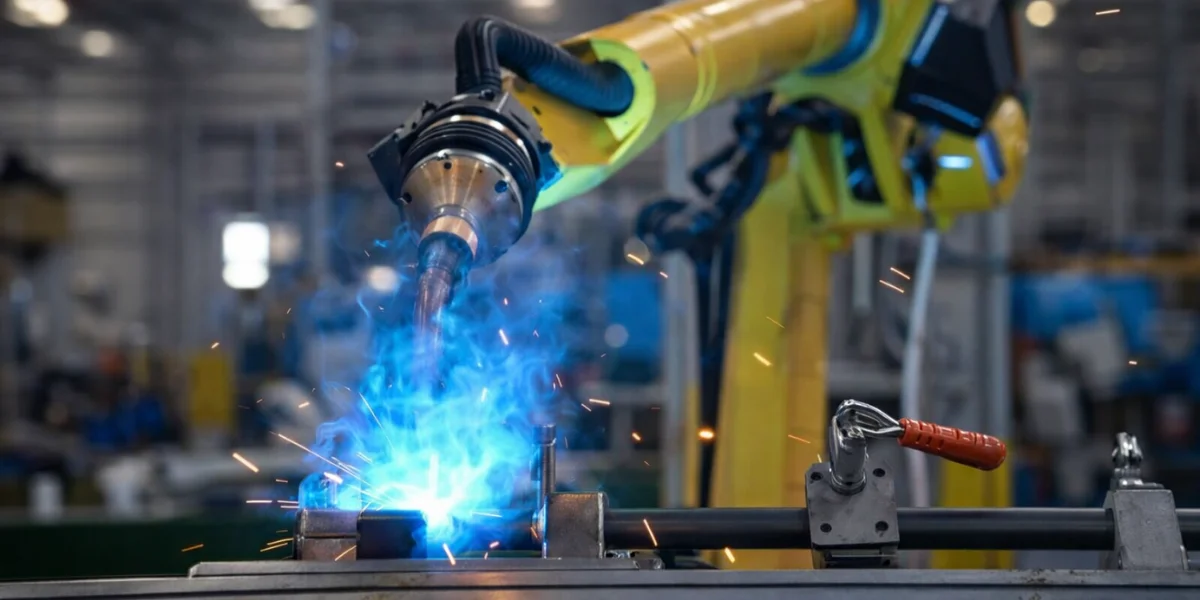
Robotic Welding Machine Manufacturer in India
Robotic Welding Machines and Automation Systems Built for Indian Manufacturing Conditions
Keje Electric Company is a leading Robotic Welding Machine Manufacturer in India Keje Electric Company designs and manufactures robotic welding machines at our MIDC Pimpri facility in Pune. We integrate industrial robots from FANUC, ABB, KUKA, and Yaskawa with MIG, TIG, spot, and resistance welding processes to build automated welding systems for automotive, heavy engineering, and appliance manufacturing plants across India. We have been building welding machines in Pimpri-Chinchwad since our founding. Robotic welding is an extension of that — the same electrical and controls engineering we apply to our spot welding, seam welding, and flash butt welding machines, applied now to robot-integrated cells. If you have worked with Keje machines before, you know how we build things. If you have not, our clients list and the Pimpri factory are both open for a visit before you decide.
What Robotic Welding Actually Solves
Manual welding works until it does not. The problem is not the welders — it is the nature of the process. A human welder doing 400 identical welds per shift will not produce 400 identical welds. Heat buildup, fatigue, torch angle variation, and wire feed inconsistency mean the 100th weld is different from the first. On low-volume work with loose tolerances, that is acceptable. Robotic Welding Machine Manufacturer in India On automotive components, pressure vessels, or anything with a quality audit, it becomes a production problem. Robotic welding fixes this by removing the variation. The robot follows the same path, at the same speed, with the same arc parameters, on every single cycle. Weld 1 and weld 10,000 are the same. The output is predictable enough to measure and certify. What actually determines whether your robotic welding system works is not the robot brand — it is the fixture design, the programming, and the process parameters. A poorly fixtured component moves under the torch. A poorly programmed robot repeats the wrong path. Getting this right is what we do. The robot is just the tool.
At Keje Electric Company, we offer
We build robotic welding systems for MIG, TIG, spot, and resistance welding applications. Each system is designed to the component drawing and production rate — not pulled from a standard catalogue. Here is what we deliver across our robotic welding range:
Automated Precision
Automated Precision Text : FANUC and ABB robots hold positional repeatability to ±0.02mm. The torch follows the same path every cycle — no drift, no correction needed between shifts.
Enhanced Productivity
Enhanced Productivity Text : A robot cell runs at consistent speed across all three shifts. No slowdown for fatigue, no quality drop at the end of a shift. Throughput is predictable and schedulable.
Customizable Solutions
Customizable Solutions Text : Systems are designed to your component — fixture layout, robot reach, weld sequence, and safety guarding are all project- specific.Robotic Welding Solutions Provider in India Nothing is off-the-shelf here.
Advanced Safety
Advanced Safety Text : All cells include light curtains, safety-rated interlocked fencing, and emergency stop circuits. Designed to ISO 10218-1 and ISO 10218-2 robot safety standards.
Features of Our Robotic Welding Machines
Robot Brands Integrated: FANUC, ABB, KUKA, and Yaskawa Motoman — selected by application, payload requirement, and client infrastructure compatibility. Specification Details Robot Brands FANUC / ABB / KUKA / Yaskawa (Motoman) Welding Processes MIG / TIG / Spot / Seam / Resistance Welding Robot Payload Range 6 kg to 500 kg (application dependent) Robot Reach 1,400mm to 3,500mm Repeatability ±0.02mm to ±0.08mm Welding Power Sources Fronius / OTC Daihen / Lincoln Electric / Miller PLC Platform Siemens S7 / Allen Bradley / Mitsubishi iQ-R Material Thickness Range 0.8mm to 50mm (process dependent) Safety Standards ISO 10218-1 / ISO 10218-2 Safety Devices Light curtains / Interlocked fencing / Area scanners Commissioning At customer plant — pan-India Warranty 12 months from commissioning
Welding Processes Covered: MIG (GMAW), TIG (GTAW), spot welding, seam welding, and resistance welding — all processes we already manufacture standalone machines for.
Welding Power Sources: Fronius, OTC Daihen, Lincoln Electric, and Miller are paired to process material based on arc stability and duty cycle requirements.
Positional Repeatability: ±0.02mm to ±0.08mm depending on robot model and payload. Verified during factory acceptance testing before dispatch.
PLC and Control Integration: Siemens S7, Allen Bradley, and Mitsubishi iQ-R PLC platforms. HMI on Siemens WinCC or Rockwell FactoryTalk as specified.
Fixture Design Included: Every cell includes purpose-built welding fixtures fabricated from MS, EN8, or cast iron. Fixtures are designed and made in-house — not sourced separately Robotic Welding Machine Supplier in India .
Multi-Station Capability: 2-station to 8-station robotic lines with automated component transfer for high-volume production requirements.
After-Commissioning Support: 12-month technical warranty. Preventive maintenance schedule. Operator training on programming, fault diagnosis, and safe restart.
Applications of Robotic Welding Machines
Our robotic welding solutions are widely used across industries in India, especially where consistency and speed are critical.
-
Automotive OEM and Tier 1 Suppliers: Chassis subassembly, BIW spot welding, exhaust system fabrication, fuel tank brackets, and structural components. Pune's Chakan and Talegaon belt is our primary automotive client zone
-
Two-Wheeler and Three-Wheeler Manufacturing: Frame welding automation, swing arm fabrication, fuel tank production. High-speed spot and MIG cells for frame rail and subassembly lines.
-
Heavy Engineering and Construction Equipment: Loader bucket welding, excavator boom fabrication, structural frame welding for agricultural and material handling equipment. Heavy arc welding cells with positioners for large components.
-
Electrical Equipment Manufacturing: Enclosures and assemblies
-
Appliance Manufacturing: Washing machine drum assemblies, refrigerator components, motor housings. High-volume resistance and MIG welding with fast cycle times.
-
Electrical Equipment Manufacturing: Transformer tanks, panel enclosures, busbar assemblies, and switchgear structural frames. Keje Electric's own product range overlaps here — we weld the same types of assemblies in our own factory.
-
Defence and Aerospace Fabrication:Precision TIG welding of aluminium and stainless steel components with strict weld quality documentation and traceability requirements.
Frequently Asked Question
What is a robotic welding machine?
A robotic welding machine is an industrial robot arm fitted with a welding torch or gun that performs welding automatically following a pre-programmed path. The robot repeats the same weld sequence on every component cycle. The torch position, travel speed, wire feed rate, and arc parameters are all controlled by the program — not by an operator in real time. The result is that every component coming off the line gets the same weld, regardless of shift, operator, or time of day.
What are the benefits of robotic welding over manual welding?
The main benefit is consistency. A manual welder doing 400 welds per shift will show variation across those welds — that is human. A robot doing 400 welds per shift produces the same weld every time. Beyond consistency: robots run three shifts without fatigue, weld in positions difficult or unsafe for humans, and handle rejection rates significantly lower than manual production on the same component. The trade-off is upfront cost and the time needed to program and fixture the system correctly — which is why choosing the right integration partner matters.
Which welding processes can be automated with robots?
MIG welding is the most common — it handles mild steel, high-strength steel, and aluminium for most automotive and structural applications. TIG welding is used where weld finish and metallurgical quality are critical — stainless steel, aluminium, and thin-gauge materials. Spot welding robots are used in automotive BIW production for body panel assembly. Seam welding and resistance welding can also be robotised. We manufacture standalone machines for all of these processes at our Pimpri facility — so the process knowledge is in-house, not sourced from a third party.
What maintenance do robotic welding systems need?
Three categories. First, the robot itself — periodic lubrication of joints, cable inspection, and teach pendant calibration. FANUC and ABB publish maintenance intervals in their manuals and we provide these at handover. Second, the welding process components — contact tip replacement, liner cleaning, gas nozzle inspection, and torch alignment checks. These are consumable-related and frequency depends on production volume. Third, the fixture — checking clamp function, locator wear, and weld spatter buildup. We provide a preventive maintenance checklist and conduct the first PM visit at the 3-month mark after commissioning.
Do you provide the complete robotic welding system including fixtures and programming?
Yes. We design the fixture, fabricate it at our Pimpri unit, program the robot offline before installation, and commission the full cell at your plant. You do not need to source the fixture from one vendor and the programming from another. The entire scope — robot, welding system, fixture, PLC, safety guarding, and operator training — is one contract with one point of accountability.
How long does operator training take for a robotic welding system?
For operators — the people who load components, start cycles, and respond to faults — training takes 3 to 5 days. They need to understand safe entry and exit from the cell, fault codes and restart procedures, and basic quality checks on completed welds. For maintenance engineers who will troubleshoot and adjust programs, 2 to 3 weeks of structured training is realistic. We conduct both at your plant during and after commissioning. We also return for retraining if staff changes occur within the warranty period.
Our Welding & Forming Solutions :
Get In Touch :
Lorem ipsum dolor sit amet, consectetur adipiscing elit. Ut elit tellus, luctus nec ullamcorper mattis, pulvinar dapibus leo.
Ready to Automate Your Welding Process?
Tell us your component, production volume, and current welding process. Our engineering team reviews the requirement and responds within 24 hours with a technical approach and indicative scope. No obligation.